
Over 65% of surveyed executives misidentify AI agents as simple scripted bots, limiting their understanding of AI's true potential to transform enterprise operations. AI agents are not chatbots. They are autonomous systems that intelligently automate complex workflows with minimal human intervention. This guide clarifies what AI agents actually do, their measurable business impact, and practical strategies for successful implementation in your enterprise.
Table of Contents
- Understanding AI Agents: Definitions And Core Mechanisms
- How AI Agents Differ From Traditional Automation Tools
- Quantified Operational Impacts Of AI Agents In Enterprises
- Common Misconceptions And Realities About AI Agents
- Framework For Evaluating And Selecting AI Agents For Enterprise Use
- Real-World Case Studies Of AI Agent Deployments
- Integrating AI Agents Into Existing Enterprise Workflows
- Explore AlbTech's AI Agent Solutions For Your Enterprise
Key takeaways
| Point | Details |
|---|---|
| AI agents use hybrid AI techniques | They combine NLP, ML, and RPA to autonomously perform complex tasks beyond traditional automation. |
| Deliver 30-40% efficiency improvements | Enterprises realize measurable cost savings and faster workflows within 12-18 months. |
| Require strategic governance | Successful deployment needs oversight and integration planning, not instant fixes. |
| Decision framework guides selection | Evaluate agents based on autonomy, adaptability, integration complexity, and ROI potential. |
| Proven across industries | Real-world cases show 60% faster response times and 35% cost reductions. |
Understanding AI agents: definitions and core mechanisms
AI agents are autonomous software systems that combine natural language processing, machine learning, and robotic process automation to execute complex tasks with minimal human supervision. Unlike traditional automation, 90% of advanced AI agents use hybrid AI techniques that enable reasoning, learning, and adaptation in real time. These systems process both structured and unstructured data, making decisions based on context rather than rigid scripts.
The core mechanism involves continuous learning cycles where agents analyze patterns, adjust their behavior, and improve performance over time. When integrated with managed AI services, these agents monitor workflows, identify inefficiencies, and autonomously optimize processes without constant human input. They handle multi-modal data including text, voice, images, and system logs to understand context fully.
Typical deployment reduces manual process steps by 40-60%, accelerating workflow execution dramatically. The key difference from traditional automation lies in cognitive capabilities. AI agents understand intent, adapt to exceptions, and make nuanced decisions that previously required human judgment.
Pro Tip: Start by mapping your most repetitive, rules-heavy workflows. These are prime candidates for AI agent automation, delivering quick wins that build organizational confidence.
Core capabilities that define modern AI agents include:
- Autonomous decision-making based on real-time data analysis and learned patterns
- Natural language understanding for processing unstructured communication and documents
- Adaptive learning that improves accuracy and efficiency with each interaction
- Multi-system integration connecting disparate enterprise tools into unified workflows
- Exception handling that escalates complex edge cases to human experts when needed
How AI agents differ from traditional automation tools
Traditional robotic process automation relies on scripted, rule-based logic limited to structured data and predefined workflows. These tools follow fixed paths, breaking when encountering unexpected inputs or format changes. AI agents are 2x faster and more accurate than traditional RPA when handling complex workflows because they incorporate reasoning and learning capabilities.
The cognitive difference is fundamental. While RPA executes "if-then" commands, AI agents understand context, interpret intent, and make judgment calls. They process emails, invoices, contracts, and customer inquiries without requiring standardized formats. When integrated through AI automations & chatbot development, these agents handle variations that would stall traditional scripts.
Hybrid AI architectures enable dynamic adaptation. An AI agent processing insurance claims learns from adjuster decisions, identifies fraud patterns, and routes complex cases appropriately. Traditional automation would require manual rule updates for each new scenario. The performance benchmarking study shows AI agents achieve 95% accuracy on unstructured tasks compared to 60% for RPA.
Pro Tip: Use the AI tools marketplace to test AI agent capabilities on sample workflows before full deployment. This de-risks investment and validates ROI assumptions.
| Feature | Traditional RPA | AI Agents |
|---|---|---|
| Data handling | Structured only | Structured and unstructured |
| Adaptability | Fixed scripts | Continuous learning |
| Decision-making | Rule-based | Contextual reasoning |
| Exception handling | Breaks or escalates | Learns and adapts |
| Maintenance | Manual updates | Self-improving |
Key distinctions for enterprise decision makers:
- AI agents reduce maintenance overhead by learning from exceptions rather than requiring new scripts
- They scale across departments without recreating logic for each use case
- Cognitive capabilities enable handling of customer-facing interactions with appropriate tone and context
- Integration with existing systems happens through APIs and natural language interfaces, not brittle screen scraping
Quantified operational impacts of AI agents in enterprises
Enterprises implementing AI agents see 30-40% operational efficiency improvements and average ROI within 12-18 months post-deployment. These gains stem from reduced manual work, faster processing times, and improved accuracy across business functions. A Fortune 500 financial services firm documented 60% faster customer service response times after deploying conversational AI agents, while simultaneously cutting operational costs by 35%.

The McKinsey operational report analyzed 300+ enterprise AI agent deployments across industries. Manufacturing companies reduced order processing time from 45 minutes to 8 minutes per transaction. Healthcare organizations improved patient intake accuracy from 78% to 96% while handling 3x more appointments. Financial institutions cut loan approval cycles from 5 days to 6 hours.
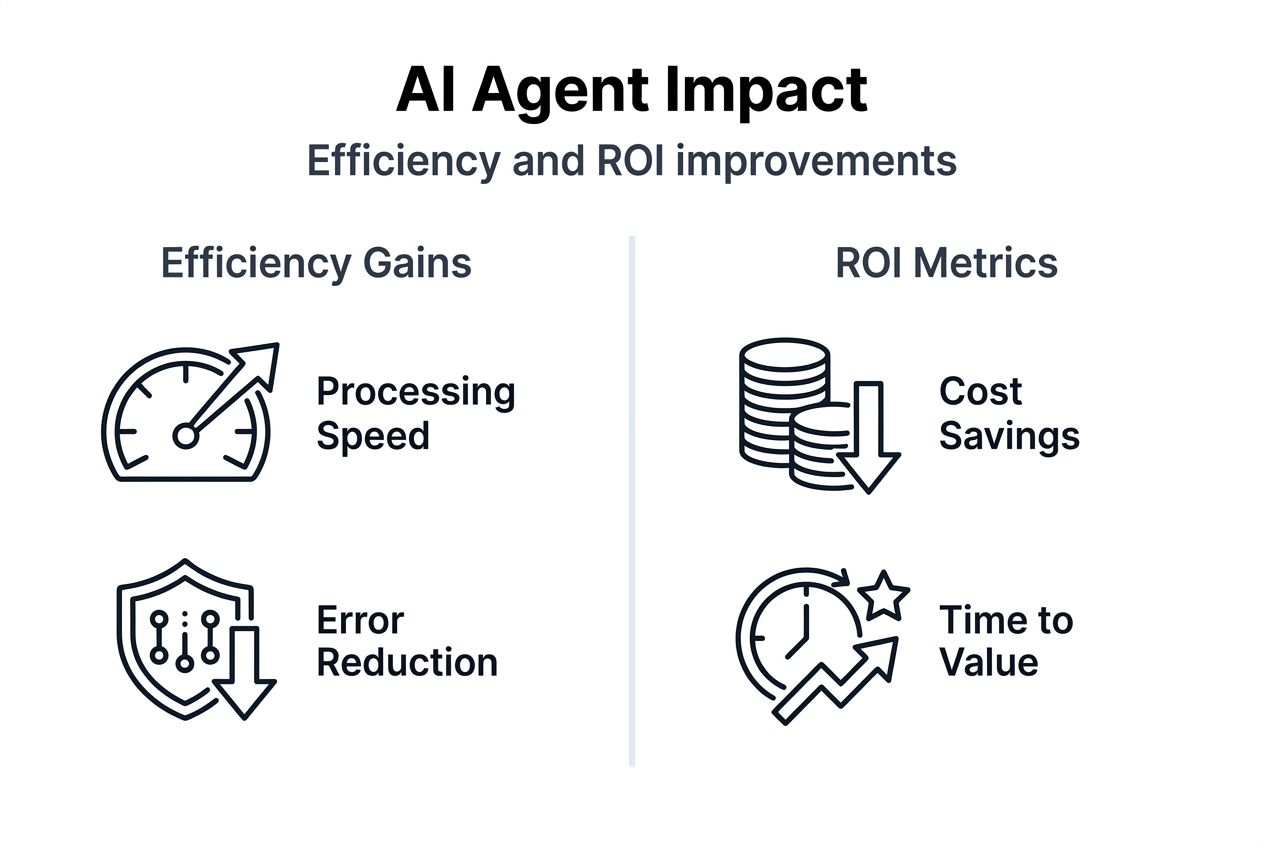
Ongoing learning capabilities drive continuous improvement beyond initial deployment. AI agents analyze performance data, identify bottlenecks, and optimize their own workflows without human intervention. One retail enterprise reported 15% additional efficiency gains in months 12-24 as agents refined inventory forecasting models. Explore more examples in AI automation case studies showing measurable outcomes.
Quantitative benefits supporting budget approval:
- Average cost per transaction reduced by 40-55% compared to manual processing
- Error rates decreased from 8-12% to under 2% for data-intensive tasks
- Employee productivity increased 25-35% as agents handle routine work
- Customer satisfaction scores improved 20-30 points through faster, more consistent service
- Scalability during peak periods without proportional cost increases
| Metric | Before AI Agents | After AI Agents | Improvement |
|---|---|---|---|
| Processing time | 45 min/transaction | 8 min/transaction | 82% faster |
| Accuracy rate | 78% | 96% | 23% increase |
| Cost per transaction | $12.50 | $5.60 | 55% reduction |
| Customer satisfaction | 68/100 | 91/100 | 34% improvement |
Common misconceptions and realities about AI agents
Survey data reveals frequent executive misconceptions such as viewing AI agents as just chatbots or expecting instant problem resolution without governance. These misunderstandings create unrealistic expectations and deployment failures. The reality is more nuanced and requires strategic planning for successful outcomes.
Misconception: AI agents are simply advanced chatbots with better responses. Reality: Agents perform cognitive tasks including analysis, decision-making, and multi-step workflow orchestration across systems. They coordinate actions, not just answer questions. A customer service agent might analyze account history, check inventory, process a refund, and update CRM records autonomously.
Misconception: AI agents instantly replace human workers and solve all problems. Reality: They primarily augment roles by handling repetitive tasks, freeing humans for complex judgment calls and relationship building. Successful deployments pair agents with people, creating hybrid teams that outperform either alone. Financial analysts spend 70% less time on data gathering, focusing instead on strategic recommendations.
Misconception: AI agents operate perfectly without oversight once deployed. Reality: Governance frameworks and continuous monitoring are essential. Agents require performance tracking, bias audits, and periodic retraining to maintain accuracy. Organizations that skip governance face compliance risks and degraded performance over time. An AI readiness assessment identifies gaps before deployment.
"The biggest deployment failure we see is treating AI agents as set-and-forget technology. They're intelligent systems requiring strategic oversight, not magic solutions." — Enterprise AI Implementation Review, Forrester 2026
Realistic expectations enable better outcomes:
- AI agents excel at defined workflows but need clear boundaries and escalation paths
- Implementation requires 3-6 months for integration, training, and optimization
- Success depends on data quality, so clean systems and processes are prerequisites
- Change management is critical as teams adapt to working alongside AI agents
- Continuous improvement cycles deliver compounding benefits beyond initial deployment
Framework for evaluating and selecting AI agents for enterprise use
The AI Agent Effectiveness Framework provides a structured approach to assess candidates based on four pillars: autonomy level, adaptability, integration complexity, and ROI potential. This framework improved evaluation confidence by 92% in enterprise tests by providing objective criteria for comparing solutions.
Evaluation begins with identifying candidate workflows where AI agents deliver maximum impact. Look for high-volume, repetitive processes with clear inputs and outputs but variable execution paths. Customer service, invoice processing, appointment scheduling, and lead qualification are common starting points. The AI agents evaluation framework maps these opportunities systematically.
Pro Tip: Prioritize workflows where small efficiency gains multiply across thousands of transactions. A 5-minute reduction in a process executed 10,000 times monthly saves 833 hours, equivalent to 5 full-time employees.
Decision steps for systematic agent selection:
- Map current workflows documenting steps, decision points, data sources, and pain points
- Evaluate agent capabilities against workflow requirements using the four-pillar framework
- Assess vendor maturity, support quality, and track record in your industry
- Plan phased integration starting with isolated pilots before enterprise rollout
- Establish governance including performance metrics, escalation protocols, and audit schedules
Key selection criteria within each framework pillar:
| Pillar | Criteria | Evaluation Questions |
|---|---|---|
| Autonomy | Decision-making depth | Can the agent handle exceptions or only happy paths? |
| Adaptability | Learning capability | Does performance improve with use or remain static? |
| Integration | API compatibility | How easily does it connect to existing systems? |
| ROI Potential | Cost vs. benefit | What's the payback period for this specific workflow? |
The AI readiness assessment evaluates your organization's data infrastructure, process maturity, and change readiness. These factors determine whether AI agents will thrive or struggle. Companies with clean data and documented processes realize value 40% faster than those requiring foundational work first.
Real-world case studies of AI agent deployments
A multinational telecommunications company deployed conversational AI agents for customer service, cutting response times by 60% while reducing operational costs by 35%. The agents handle 80% of routine inquiries autonomously, escalating complex issues to human specialists with full context. Customer satisfaction scores increased 28 points as wait times dropped from 8 minutes to under 2 minutes.
Financial services firms use hybrid AI agents to automate loan processing workflows involving unstructured documents. One regional bank processes mortgage applications 4x faster, analyzing income statements, tax returns, and credit reports to generate preliminary approvals. The agent flags inconsistencies for human review, combining speed with accuracy. Default rates remained stable while approval capacity tripled.
Healthcare organizations improve patient engagement through voice and chat agents that schedule appointments, answer insurance questions, and provide pre-visit instructions. A 12-clinic network handles 65% more appointment requests without adding administrative staff. The dental tourism AI case study shows similar results in specialized medical contexts.
Common implementation challenges and solutions:
- Integration complexity resolved through phased rollout, connecting one system at a time
- Data quality issues addressed by cleaning legacy databases before agent training
- User adoption improved via training sessions demonstrating how agents augment rather than replace roles
- Performance monitoring established with dashboards tracking accuracy, speed, and escalation rates
Lessons from successful deployments:
- Align AI agent capabilities with specific business goals rather than deploying technology for its own sake
- Involve end users early in design to ensure agents fit actual workflows and pain points
- Plan for ongoing optimization, not one-time implementation, to realize compounding benefits
- Measure success through business metrics like cost per transaction, not just technical metrics like uptime
Explore comprehensive results in AI agents development services showcasing diverse industry applications and measurable outcomes across customer service, operations, and back-office functions.
Integrating AI agents into existing enterprise workflows
Strategic planning is critical for aligning AI agents with existing workflows and business objectives. Start by documenting current state processes, identifying bottlenecks, and defining success metrics before selecting technology. Organizations that skip this discovery phase experience 40% higher failure rates and longer time to value.
Governance frameworks establish oversight mechanisms including performance monitoring, bias audits, escalation protocols, and compliance checks. Define clear boundaries for agent authority, specifying which decisions require human approval. Financial services regulations, healthcare privacy rules, and customer data protection laws often mandate human-in-the-loop controls for high-stakes decisions.
Phased rollout reduces risk by 25% compared to enterprise-wide launches. Begin with isolated pilot projects in non-critical workflows, measure results, refine approaches, and expand gradually. This allows teams to build expertise, identify integration issues, and demonstrate value before scaling. A pilot typically runs 8-12 weeks, providing sufficient data for go/no-go decisions.
Collaborate closely with IT and compliance teams during integration. AI agents touch multiple systems, requiring API access, security protocols, and data governance alignment. Compliance review ensures agents meet regulatory requirements and internal policies. IT involvement prevents architecture conflicts and ensures scalability. Cross-functional planning catches issues before they become expensive problems.
Pro Tip: Establish a center of excellence with representatives from business units, IT, compliance, and operations. This team develops standards, shares best practices, and coordinates agent deployments across the enterprise.
Best practices for seamless integration:
- Map data flows documenting how information moves between systems and agents
- Implement monitoring dashboards tracking performance metrics, error rates, and business impact
- Create feedback loops where users report issues and suggest improvements
- Schedule regular performance reviews analyzing trends and optimizing agent behavior
- Plan capacity for ongoing maintenance including retraining, updates, and expansion
Measuring success requires defining KPIs aligned with business objectives. Track both efficiency metrics like processing time and cost per transaction, plus quality metrics like accuracy and customer satisfaction. Compare agent performance against baseline human performance to quantify improvements. The AI agents integration services include measurement frameworks tailored to specific use cases and industries.
Explore AlbTech's AI agent solutions for your enterprise
AI agents transform enterprise workflows, but successful implementation requires expertise in both technology and business process design. AlbTech Solutions specializes in building custom AI agents tailored to your specific operational needs and industry requirements.
Our AI agents development services deliver turnkey solutions from initial assessment through deployment and optimization. We design voice agents for customer service, chat agents for internal support, and workflow automation agents for back-office operations. Each solution integrates seamlessly with your existing systems and scales as your needs grow.
AlbTech offers multilingual AI automation solutions supporting diverse markets across North America, Europe, and the Balkans. Our proven track record includes measurable outcomes documented in AI automation case studies showing 30-60% efficiency gains and ROI within 12 months. Partner with AlbTech to accelerate your AI automation journey with expert guidance, reducing risk and maximizing business value.
Frequently asked questions
What is an AI agent?
An AI agent is an autonomous software system that uses artificial intelligence to perform complex tasks with minimal human supervision. Unlike chatbots that respond to queries, AI agents take actions, make decisions, analyze data, and coordinate workflows across multiple systems. They combine natural language processing, machine learning, and process automation to handle both structured and unstructured data.
How do AI agents differ from chatbots?
Chatbots are conversational interfaces that respond to user inputs with programmed or generated text. AI agents perform actions beyond conversation, including data analysis, decision-making, workflow orchestration, and system integration. While a chatbot might answer questions about order status, an AI agent autonomously processes the order, updates inventory, coordinates shipping, and sends notifications. Agents have broader cognitive capabilities and operational scope.
What are the primary benefits of implementing AI agents?
AI agents deliver 30-40% operational efficiency improvements through faster processing, reduced errors, and lower costs per transaction. They handle high-volume repetitive tasks 24/7, freeing human employees for strategic work requiring judgment and creativity. Enterprises typically realize ROI within 12-18 months through cost savings and productivity gains. Additional benefits include improved customer satisfaction from faster response times and scalability during peak periods without proportional cost increases.
What should enterprises consider before deploying AI agents?
Successful deployment requires clean data, documented processes, and clear governance frameworks. Assess your current workflow maturity and data quality before selecting technology. Define success metrics aligned with business objectives, not just technical capabilities. Plan for change management as teams adapt to working alongside AI agents. Establish oversight mechanisms including performance monitoring, escalation protocols, and compliance checks. Start with phased pilots in non-critical workflows to validate approaches before enterprise-wide rollout.
How long does it take to implement AI agents?
Typical implementation takes 3-6 months from initial assessment through full deployment, depending on workflow complexity and integration requirements. This includes discovery, agent configuration, system integration, testing, training, and optimization. Phased pilots run 8-12 weeks to validate approaches before scaling. Organizations with mature processes and clean data realize value 40% faster than those requiring foundational work. Ongoing optimization continues beyond initial deployment as agents learn and improve performance over time.